
Unlike many competitors, regardless of tobacco content, Marlboro Double Mix (or sometimes called Marlboro Double Fusion) has at least one undeniable advantage: they’re available everywhere. And there are plenty of positive reviews about this brand. Today I will take a closer look at these cigarettes, taking into account the most popular reviews. These might actually be decent cigarettes!
Table of Contents

Almost everyone who speaks enthusiastically about Double Mix are smokers in their early 20s, whose tastes often differ radically from established tobacco enthusiasts. Even with these particular cigarettes. Although those “two buttons” were specifically designed for such a young audience from the very beginning. Do you remember the colors of cigarette packs that were around just recently? When a red pack guaranteed that the brand’s strongest cigarettes were inside, while a white pack guaranteed the lightest. It seems that all this no longer works, at least not in the same way it used to… Actually, it works great, but the colors aren’t focused on smoke strength, but solely on the target audience.
I remember back in the 2000s, in Europe, they conducted focus group studies on different ages to determine which colors were preferred by which group. I won’t bore you with all the results, but around that time, it became clear that people up to 30–35 years old preferred black, while smokers over 40 avoided it. Thus, based on those studies, we can conclude that the modern version of Marlboro Double Mix was originally intended for young people, and it is not surprising that most of the reviews about it were left by young people.
Filter
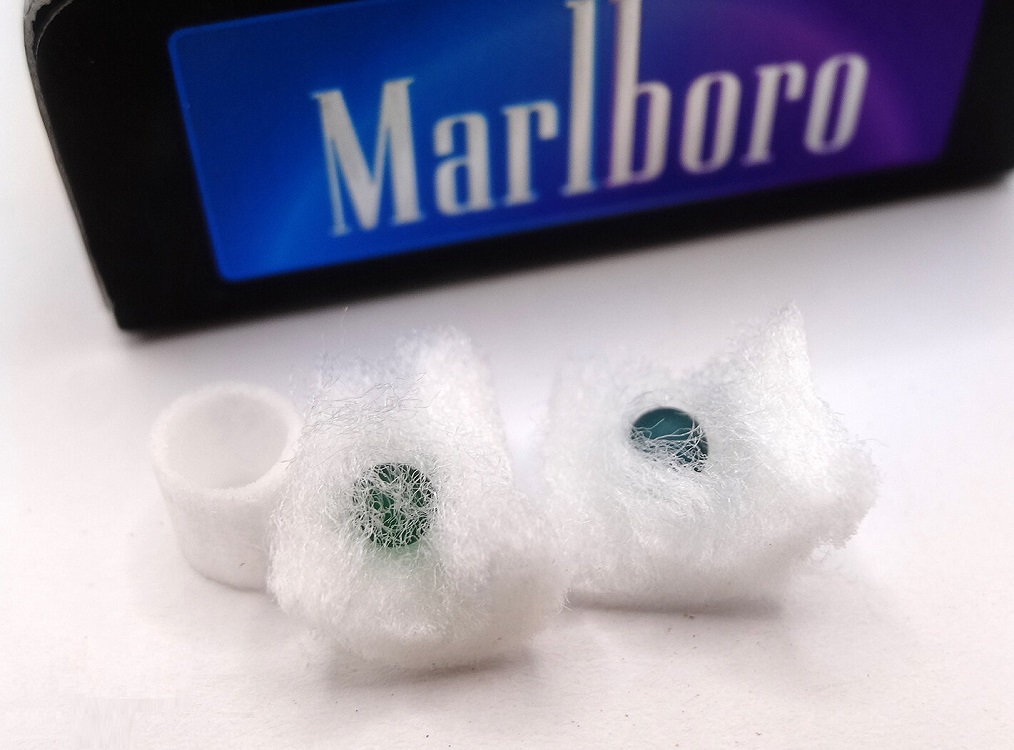
Structurally, the Double Mix compact is little different from most competitors: cigarettes burn quickly, a high-tech three-section filter with capsules inside, and noticeable perforations in its paper casing. The only distinctive feature, in my opinion, is the filter itself. The short Marlboro mouthpiece is the thinnest, with both sections made of acetate fiber, but with different weave densities, and the paper body being a dense, almost cardboard tube.
Blend
The inside of the bag is mostly light yellow, with minimal inclusions of both lighter and slightly darker shades. The tobacco blend is cut quite finely and consists of short strips with significant addition of tobacco veins. Additionally, fragments with a paper-like texture are quite common. In general, you shouldn’t expect any purely tobacco flavors with this composition.
I found it amusing, but almost all the reviews cited the flavor selection as the biggest draw of these cigarettes. Moreover, most often the selection is limited to just a couple of capsule flavors, meaning the third “choice” of the tobacco filling itself is barely considered. Although there were reviews that emphasized the tobacco flavor with the aroma considered a secondary benefit.
In the smoke there’s a monotonous woody note with a fair amount of bitterness and a hint of acridity, nothing more. The smoke’s strength is around 4 out of 10, but if you manage to block the filter perforations, you can get a slightly denser and seemingly stronger smoke. If you smoke with the capsules activated, the purple one produces a minty, candy-like flavor with a very subtle berry undertone, while the blue one produces a moderately pungent menthol. The first capsule completely masks almost all the negative flavors of the cigarette filling, and the second one is capable of masking not only the tobacco flavor but also the berry flavor of the purple capsule.
In the reviews I found, Double Mix is often called the best alternative to the crushball Rothmans and Winstons, and I tend to agree. And what about the “tobacco flavor”? You can’t blame young people for such amateurish reviews; they most likely just don’t know what cigarettes with tobacco inside taste like and judge only by what the modern tobacco industry offers them.