

Contents
1. History
The first mentions of tobacco and “prototypes” of cigarettes date back to the ancient civilizations of South and Central America. Cigarettes became widespread in Europe after the Crimean War, when Russian and Turkish soldiers wrapped tobacco in paper gunpowder cartridges or newspaper clippings. This method was soon adopted by Europeans, and then mass factory production began. At that time, all cigarettes were produced without filters.
The first cigarette filter was developed in 1925 by Hungarian Boris Aivaz and consisted of tightly rolled corrugated paper.
However, mass production of this technology was not immediately achieved. In the late 1920s, tobacco companies experimented with filtration methods but encountered a problem: the paper tube was difficult to securely attach to the tobacco column. Smokers had to insert the filter manually, which proved inconvenient and impractical.
A breakthrough only occurred in 1935, when British engineers created a special machine to automate this process. Four years later, the American corporation Brown & Williamson began using this technology, producing the first mass-produced cigarettes with a pre-installed filter.
In the 1930s and 1940s, filtered cigarettes remained rare, but the situation changed dramatically in the following decade. Following a series of studies, the tobacco industry experienced a real boom, and by the 1950s, filtered cigarettes had become the new standard.
2. Types of Filters
A filter is an essential component of cigarettes today. They are designed to filter out small tobacco particles and, if designed, partially cool the tobacco smoke. Filters can vary in size, density, and composition.
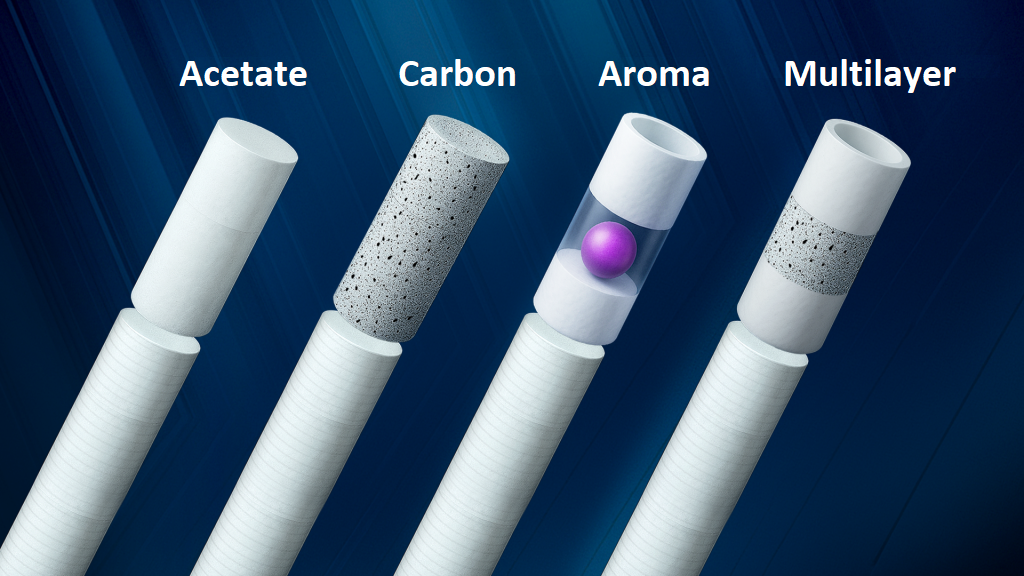
Modern options come in several main varieties, each with its own design features:
- Standard acetate filters are the most common option, consisting of tightly pressed cellulose acetate fibers.
- Carbon modifications are distinguished by the presence of an additional filter layer of activated carbon.
- Flavored versions are equipped with a special capsule containing a flavored liquid. When pressed, the capsule bursts, releasing the flavor, which adds an additional flavor to tobacco smoke.
- Multilayer filtration systems include several functional zones: a perforated air chamber, a standard acetate segment, and a carbon filter element.
The history of filtered cigarettes reflects the evolution of the tobacco industry. From their first invention in 1925 to mass production in the 1950s, filters became a standard of sorts. Their diversity today—from carbon and multi-section filters to flavored ones—demonstrates that manufacturers are constantly searching for new technologies and ways to improve filtration to meet consumer demand.