
Tobacco has been known to humans for several millennia. During this time, it has been used in a variety of ways, and processing technologies have been perfected. This article will discuss how tobacco grows, is harvested, dried, and transported to factories.
Contents
What is tobacco and where is it grown?
Tobacco cultivation technology
Storage and transportation to the factory
What is tobacco and where is it grown?
It is believed that tobacco was first cultivated by Central American Indians several thousand years BC: they stuffed the leaves into pipes and smoked them.
After the discovery of the New World, the plant was cultivated on plantations in Europe, and then in other countries. Today, the leading tobacco growers are China, India, Brazil, and the United States. Tobacco farms are common in African countries such as Zimbabwe, Malawi, Mozambique, Uganda, and others. It’s worth noting that tobacco isn’t grown on a large scale in Russia—there aren’t suitable conditions for it. Young tobacco seedlings don’t tolerate frost because its natural habitat is between the 45th parallel, where there’s no frost. In the near abroad, tobacco is common in the southern CIS—in Uzbekistan and Kazakhstan.
Common tobacco (Latin: nicotiana tabacum) is used industrially. It grows up to 3 meters tall with oblong leaves and pink flowers. It belongs to the nightshade family, like potatoes, peppers, and tomatoes. The leaves of all these crops contain alkaloids—organic alkalis that stimulate the nervous system in small amounts and depress it in larger amounts. It’s because of these alkaloids that the tops of potatoes, tomatoes, peppers, and eggplants are not used as livestock feed, as it can lead to the death of the animals.
Tobacco is unique in this regard: it is the only plant in the nightshade family whose leaves are used—but only for smoking, not for eating.
Tobacco has long been selectively bred to achieve different flavors and aromas. Three varieties are particularly popular today:
- Virginia — a light-colored tobacco with low nicotine content and a mild, sweet flavor;
- Burley — a strong tobacco with nutty notes in both flavor and aroma;
- Oriental — a variety with a subtle floral aroma and a sweet, spicy flavor.
It’s worth noting that tobacco is quite demanding: it requires plenty of light and moisture, as well as moderately fertile soil.
Seedlings
From an agronomic perspective, the plant is similar to tomatoes. It all begins with growing tobacco seedlings. They are prepared for 60 days in special beds before being transplanted into the field. The fact is that tobacco seeds are extremely small—there are about 12,000 of them in a single gram—and they resemble powdered instant coffee. Many of them will fail to thrive if planted directly in open ground.
When the shoots reach 15 centimeters and have 5-6 true leaves, they are planted in the field. This method allows you to select the healthiest and strongest specimens and plant them so that the mature plants don’t interfere with the growth of neighboring bushes.
Topping
To improve the quality and yield of tobacco, side shoots and the upper growth point are removed. This process of topping and pinching is necessary to protect the plant, allow the root system to develop, and the leaves to accumulate all the necessary nutrients. The cut is cauterized with special chemicals to prevent infection.
Harvesting, or breaking
Tobacco leaves mature gradually, so the harvesting process takes 2-4 months. Typically, harvesting is done by hand, plucking 2-4 leaves at a time, starting from the bottom of the plant and working up to the top.
Breaking tobacco is the most labor-intensive stage of tobacco cultivation. For example, the average farmer in Uganda, with 2-3 hectares of land, must process approximately 15,000 plants per season, harvesting 22 leaves from each. This requires breaking several times per season until the upper layers of leaves are ripe. Some countries, including the United States, use mechanized tobacco harvesting, but it is still mostly manual labor.
Determining the maturity of tobacco is a special art that directly affects the quality of the raw material.
Unripe leaves contain little nicotine and can cause severe irritation when smoking, as the protein has not yet broken down. Overripe leaves are empty and tasteless, as their nutrients have already been lost.
The drying method is chosen depending on the tobacco variety. The longest method is shade drying, which can take two months to dry the leaves.
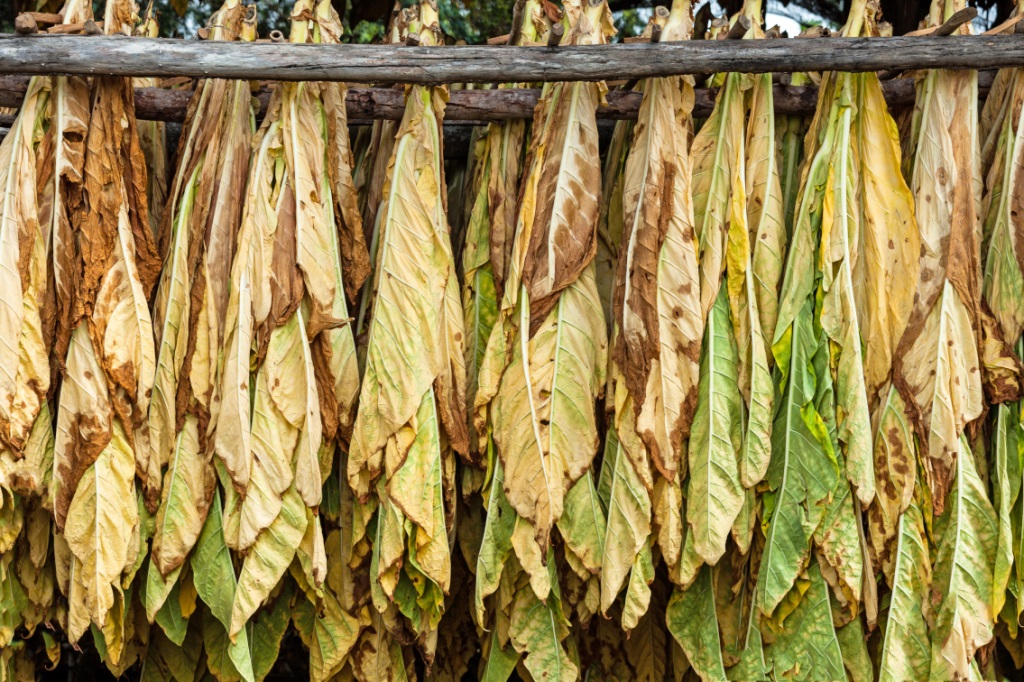
The main curing methods are:
- Flue curing – suitable for Virginia tobacco. The harvested leaves are strung on cords and sent to drying sheds, where streams of steam, hot air, or smoke are directed at them through pipes. This method keeps the leaves light while preserving their sugar content. This tobacco is less pungent when smoked.
- Air curing – used for Burley tobacco. Bundles of tobacco leaves are dried outdoors under a canopy. Fans can also be used to speed up the process. Leaves dried this way retain more nicotine.
- Sun curing – suitable for Oriental tobacco. The leaves are dried in the open sun. The sugar and nicotine content depends more on the variety than on the method.
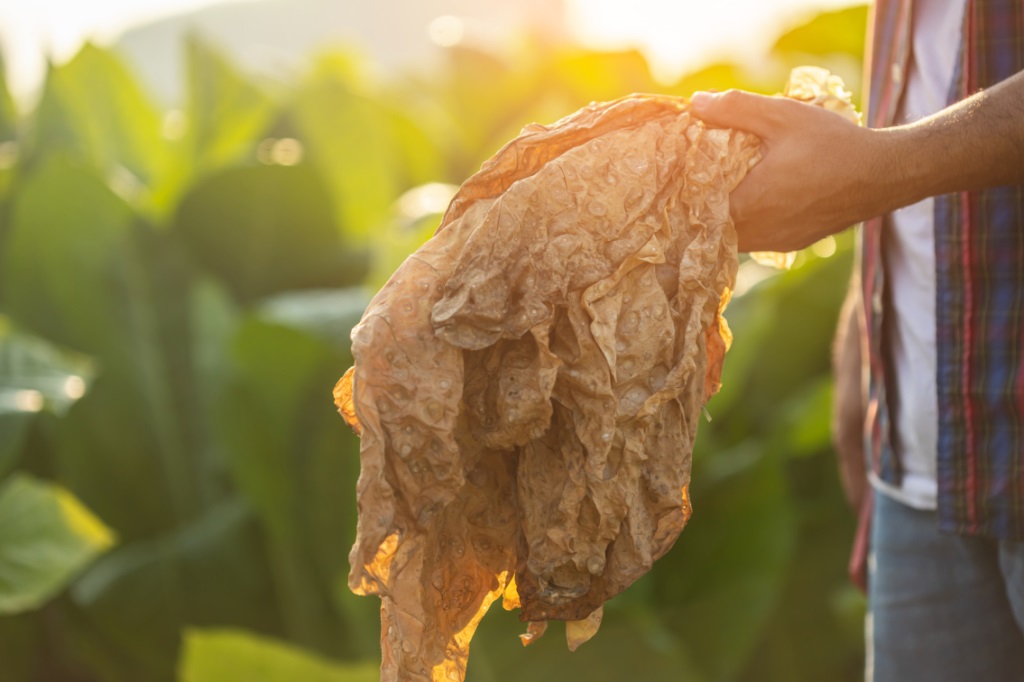
Before being shipped from the plantations to the factories, tobacco is sorted into categories, which vary depending on the maturity of the leaf and its position on the stem. Each layer of tobacco has unique flavor qualities: the lower leaves contain the least nicotine, and the content increases as you move toward the top.
Mature tobacco has the best smoking properties.
It is important to maintain the stated flavor and aroma characteristics in finished cigarettes. These qualities can be determined by the color of the raw material. For example, the darker the tobacco, the less sugar it contains. At the factory, tobacco of different categories and varieties is used to create blends to achieve the desired level of richness or smoothness.
Leaves of different categories are packaged into bales and sent to the factory or warehouse.
Storage and Transportation to the Factory
Before production, the tobacco is stored under strict conditions: at a temperature of 16-18°C and a humidity of 65-72%. Particularly strong varieties can be aged for up to two years.